 By admin
 Picture this: You’re crushing it in your favorite sport, making a killer cut or landing like a pro, and then—BAM!—you hear or feel a sickening POP! in your knee. Pain hits you like a freight train, swelling kicks in fast, and suddenly, your leg feels like a wobbly mess, ready to give out any second. This gut-wrenching moment often screams one thing: your Anterior Cruciate Ligament, or ACL, just tore. It’s one of the main cables holding your knee together, and it just snapped. Thousands of active folks face this nightmare every year, leaving them wondering, “What the hell just happened inside my knee, and how do I even move forward from this?”
The frustration? Oh, it builds quicker than a wildfire. Simple stuff like walking or climbing stairs becomes a Herculean task, your sports dreams feel miles away, and the fear of long-term damage hangs heavy like a dark cloud. But hold up, don’t throw in the towel just yet! Understanding the brutal truth of an ACL tear isn’t just about pain; it’s your first step to getting smart about recovery and dodging future bullet. Stick with me, because by the end, I’m gonna drop some real talk on practical knee health moves that most people completely miss.
What the Hell is an ACL, and Why Should You Even Care?
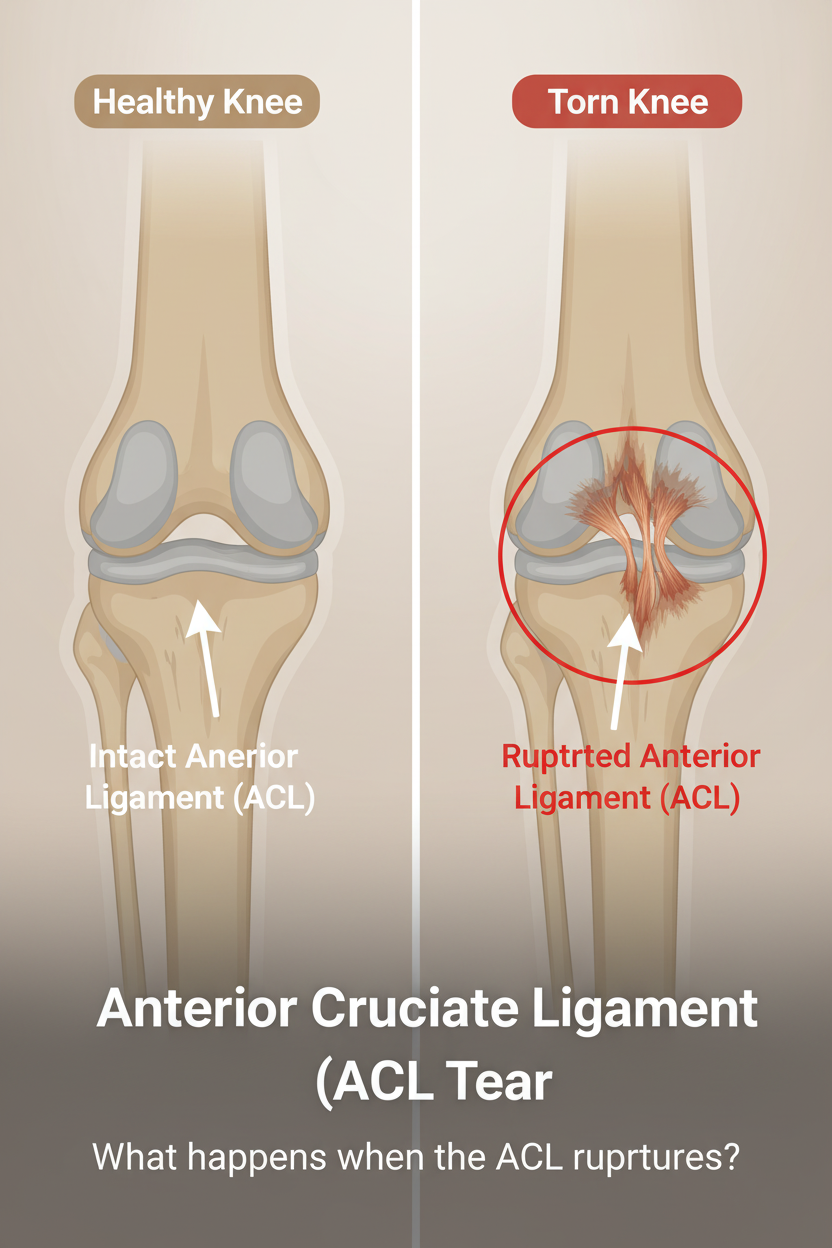
The Anterior Cruciate Ligament (ACL) isn’t just some random tendon; it’s a tough, rope-like cable deep inside your knee joint. Think of it as the main anchor connecting your thigh bone (femur) to your shin bone (tibia), working overtime with other ligaments to keep your knee from going rogue. Studies show this bad boy provides a whopping 85% of the resistance against your shin bone trying to slide too far forward, and it’s key for stopping crazy rotation during those quick pivots or sudden stops. Without its full strength? Your knee loses its damn mind, becoming a wobbly, unstable mess.
When Your ACL Goes KABOOM: What Really Breaks Down Inside
When your ACL gets hit with a force it can’t handle—usually from a sudden twist, a clumsy landing, or a non-contact pivot—it stretches beyond its breaking point. This ain’t just a minor tweak; it’s a full-on stretch that can result in a partial or, more often, a complete tear. In a complete tear (the common, nasty kind), those ligament fibers literally snap, usually right in the middle. That classic “pop” you heard? That’s the sound of your knee’s main support beam giving way. Inside the joint, it’s a tiny bloodbath: small vessels rupture, leading to rapid bleeding (hemarthrosis) and swelling that blows up your knee like a balloon. Imaging often reveals bone bruises on your thigh bone’s outer edge or the back of your shin bone, like battle scars. Your knee’s natural stability? Gone. Your shin bone can now shift forward way too easily, and any rotational forces will make your knee feel like it’s “giving way”—a truly unsettling sensation. Research screams that this ongoing instability isn’t just annoying; it stresses other crucial parts like your meniscus or cartilage over time, slowly eating them away. But that’s not the whole story. Your body immediately goes into full-blown panic mode, triggering inflammation to protect the area, which explains the agonizing pain and limited movement right after the injury.
Did Your ACL Just Bite the Dust? Here’s What You’ll Feel (And See)
If your ACL just went south, brace yourself. Most folks feel this sh*t show right after the hit:
- That sickening “POP!” or a distinct popping sensation in your knee.
- Rapid swelling that makes your knee blow up within a few hours.
- Sharp, searing pain that makes continuing any activity absolutely impossible.
- Difficulty putting any real weight on your leg, like it’s made of glass.
- A terrifying sense of your knee being totally unstable, buckling right out from under you.
That swelling ain’t just for show – it’s internal bleeding filling up the joint, making your knee stiff as a board and severely limiting your range of motion. You might manage to hobble around after the initial shock, but try to pivot or turn? Forget about it, unless you want to make things even worse.
Your Life After an ACL Blowout: Get Ready for a Reality Check
Without the ACL holding things in check, your everyday moves get flipped upside down. Walking on uneven ground, tackling stairs, or just changing direction can trigger that terrifying unstable feeling. Athletes? Your game is toast, for now. They often describe their knee “giving out” mid-play, which isn’t just humiliating; it skyrockets your risk of nasty falls or even more damage to your already busted joint. Over months, if that instability isn’t addressed, it can lead to serious wear and tear on your cartilage or meniscus. Studies are crystal clear: untreated knee instability is a direct ticket to degenerative changes in your joint. Your knee is literally eating itself alive, slowly.
So You Tore Your ACL: What’s the Game Plan?
Look, no two ACL tears are exactly the same, just like no two fights are identical. What happens next depends on a bunch of factors: how bad the tear is (partial vs. a full snap), your age, how active you are, and if you’ve got other damage (like a torn meniscus). Many start by trying to tough it out with conservative approaches – managing the pain and slowly rebuilding strength. Physical therapy becomes your new religion, focusing on kicking that swelling to the curb, getting your motion back, and beefing up the muscles around your knee to act as its new bodyguards. Some folks even strap on knee braces for extra stability. But for those itching to get back to high-demand sports or dealing with constant instability, surgical reconstruction is often the go-to, replacing your shredded ligament with a fresh graft. Ultimately, this isn’t some doctor’s order; it’s a deeply personal call, based on your lifestyle and what you need to get back to living your best, most active life.
Your Busted Knee Needs Help NOW: Practical Moves to Make
Whether your knee just got slammed or you’re trying to dodge the bullet of an ACL injury, listen up. These actionable habits aren’t just suggestions; they’re your lifeline to supporting your knee health:
- Follow RICE early on: This isn’t optional, it’s mandatory. Rest that damn knee, apply Ice wrapped in a cloth for 15-20 minutes at a time (don’t burn yourself!), Compress the area with a bandage (not too tight, don’t cut off circulation!), and Elevate your leg above your heart. This is your first, best defense against that nasty swelling and pain.
- Get Strong, Stay Strong: Don’t just focus on the knee itself. Think bigger. Beef up your glutes, hamstrings, and quadriceps. These muscles are your knee’s personal bodyguards, its support crew. A weak support system around your knee is practically an invitation for trouble. Seriously, don’t overlook this!