 By admin
 Knee Exploded? The Raw Truth About Cruciate Ligament Tears: Signs, Causes, & What Happens Next!
Imagine this: You’re absolutely crushing it on the court, tearing up the slopes like a pro. Then, out of nowhere, your knee pulls a fast one on you. You hear a sickening *POP*, a jolt of pain that’d make a grown man cry, and within minutes, that knee starts swelling up like a damn grapefruit. Sound familiar? For far too many active folks, this nightmare scenario screams one thing: a cruciate ligament tear, most often that notorious Anterior Cruciate Ligament, or ACL. This isn’t just a bump or a bruise; it’s a full-blown crisis.
This kind of injury? It’s terrifying. It derails your whole life, benches you from everything you love, and leaves you staring into the void, wondering if you’ll ever move the same way again. That wobbly, unstable feeling and constant ache can make simple stuff, like climbing stairs, feel like scaling Mount Everest. But hold on, don’t spiral into despair just yet! Here’s the good news: getting the inside scoop on exactly what goes down in your knee and knowing your battle plan can empower you to fight back and get your life on track.
In this no-nonsense guide, we’re gonna rip open the lid on what truly happens when that crucial ligament tears, the tell-tale signs, the sneaky culprits behind it, and the real-world steps you need to take for a solid comeback. Get ready to uncover vital insights that most people totally miss until it’s too late. Don’t be that person!
The MVP of Your Knee: The Crucial Role of Your Cruciate Ligament
Your knee isn’t just some simple hinge; it’s a complex piece of engineering, relying on a network of ligaments for stability. Among them are the cruciate ligaments – the Anterior (ACL) and Posterior (PCL) – which literally cross each other inside the joint like a big ‘X’. And let’s be real, the ACL is the one that usually takes the hit, the MVP that often gets benched.
This bad boy, the ACL, is the main connection between your thigh bone (femur) and your shin bone (tibia). Its job? To stop your shin bone from sliding too far forward and to keep your knee from twisting itself into a pretzel during those quick, explosive movements. When it’s healthy, this ligament is your knee’s bouncer, keeping everything locked down during high-impact action. But when it tears? Poof! That natural stability vanishes faster than your paycheck on rent day.
Orthopedic bigwigs like the Mayo Clinic confirm it: ACL tears are rampant in sports where you’re constantly stopping on a dime, jumping like a maniac, or changing direction like a squirrel on caffeine. But wait, there’s more! A tear can also wreak havoc on nearby structures, potentially messing up your meniscus or cartilage over time if you don’t get your act together and manage it right. This isn’t just about the ACL; it’s about your whole damn knee!
The Moment the Ligament Tears: What Actually Happens (It Ain’t Pretty)
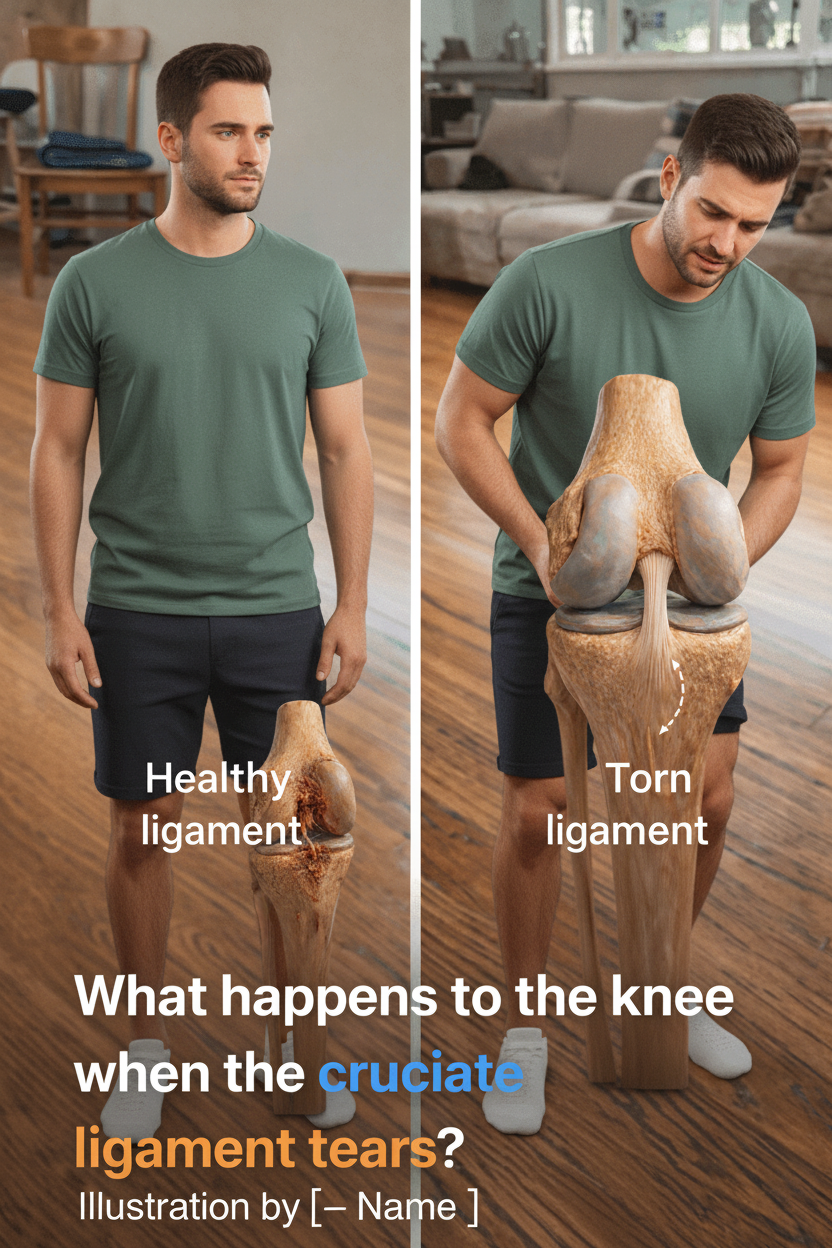
Forget those pretty diagrams of healthy ligaments. Picture a strong, intact rope holding everything together. Now, picture that rope, fibers ripped to shreds, frayed ends everywhere. That’s your ligament after it tears. Usually, this disaster strikes from a non-contact pivot or twist when your foot is planted firmly on the ground – BAM! The ligament fibers stretch past their breaking point and *snap*. Many folks swear they heard or felt a distinct “POP!” at the exact second of impact. It’s unforgettable.
What follows? Immediate, searing pain. And then, your knee starts ballooning up rapidly, thanks to internal bleeding inside the joint (that’s hemarthrosis for you medical nerds). Your knee basically loses its damn mind; it can’t stay stable. You’ll feel like it “gives way” or buckles when you try to put any weight on it or make a move. This instability is a dead giveaway, the hallmark sign, because the main thing stopping your shin bone from doing a runner is gone. Kaput.
Here’s why that’s a massive problem: Without that critical support, even simple, everyday movements become a Herculean task, and you’re basically setting yourself up for *more* injuries down the line. Don’t underestimate this; your knee is now a wobbly mess, and secondary damage is a real threat.
Recognizing the Symptoms of a Cruciate Ligament Tear: Don’t Be a Dummy!
Catching a tear early can literally change the game for your recovery. If you’re feeling any of these, don’t play hero; get it checked out:
- A loud pop or popping sensation in the knee – it’s not just your imagination!
- Rapid swelling within hours of the injury – your knee will look like a balloon.
- Severe pain that makes it hard to continue activity – forget pushing through this one.
- A feeling of instability or the knee giving out – it feels like it’s disconnecting.
- Loss of full range of motion – you can’t straighten or bend it like you used to.
- Tenderness around the joint line – touch it and you’ll know it’s angry.
If you’re ticking off these boxes, for the love of all that is holy, do NOT ignore it. Studies scream it: prompt attention can actually prevent even more catastrophic damage to your knee’s delicate structures. Don’t mess around!
The silver lining? Not every tear feels like the end of the world, and partial tears might have milder symptoms. But that gut-wrenching sensation of instability? That’s often the flashing red light telling you something seriously significant has gone wrong. Listen to your body!
Common Causes Behind Cruciate Ligament Injuries: How Did This Happen?!
Cruciate ligament tears aren’t usually born from some epic collision. Nope, they’re often the result of those sneaky, non-contact moves. Here’s how these disasters typically strike:
- Sudden pivoting or cutting movements in high-octane sports like soccer, basketball, or tennis – think quick changes of direction.
- Landing awkwardly from a jump – gravity is not always your friend.
- Abrupt stops while running – putting the brakes on too hard.
- Skiing accidents involving twisting falls – when your skis decide to go one way and your body another.
And ladies, listen up: you tend to face a higher risk. Why? Factors like wider pelvis angles and hormonal influences on ligament laxity play a role, according to various orthopedic research. Other risk factors include being out of shape, wearing crappy footwear, or playing on surfaces that are basically booby traps. Understanding these triggers isn’t just academic; it helps you stay sharp and mindful when you’re out there living your life.
What to Do Right After a Suspected Tear: Don’t Panic, Act Fast!
Alright, so the damage is done. What now? The first 48 hours are absolutely CRITICAL, people. Most experts will scream this from the rooftops: Get on that RICE protocol like your recovery depends on it – because it does!
- Rest: Avoid putting any weight on that injured knee. Seriously, give it a break.
- Ice: Apply ice packs for 15-20 minutes every 2-3 hours. This helps keep the swelling monster at bay.
- Compression: Use an elastic bandage to gently compress the knee. This also helps reduce swelling.
- Elevation: Prop your leg up above your heart level whenever possible. Let gravity work for you to drain that fluid.
Remember, this isn’t just a sprain you can walk off. A cruciate ligament tear is a serious injury that demands immediate attention and a proper game plan for recovery. Don’t leave your knee’s future to chance!
That’s the brutal truth about what happens when your cruciate ligament decides to call it quits. We hope this deep dive arms you with the knowledge to understand, react, and recover like a champ. Your health is your wealth, and we’re here to help you protect it.
Stay strong, stay informed, and keep pushing forward! For more cutting-edge health insights and tips that actually work, make sure to explore other articles right here on dogpjs.com. Your journey to a healthier, stronger you starts now!