 By admin
 Chinese Body Clock: Waking Up at Odd Hours? Here’s What Your Body’s REALLY Telling You!
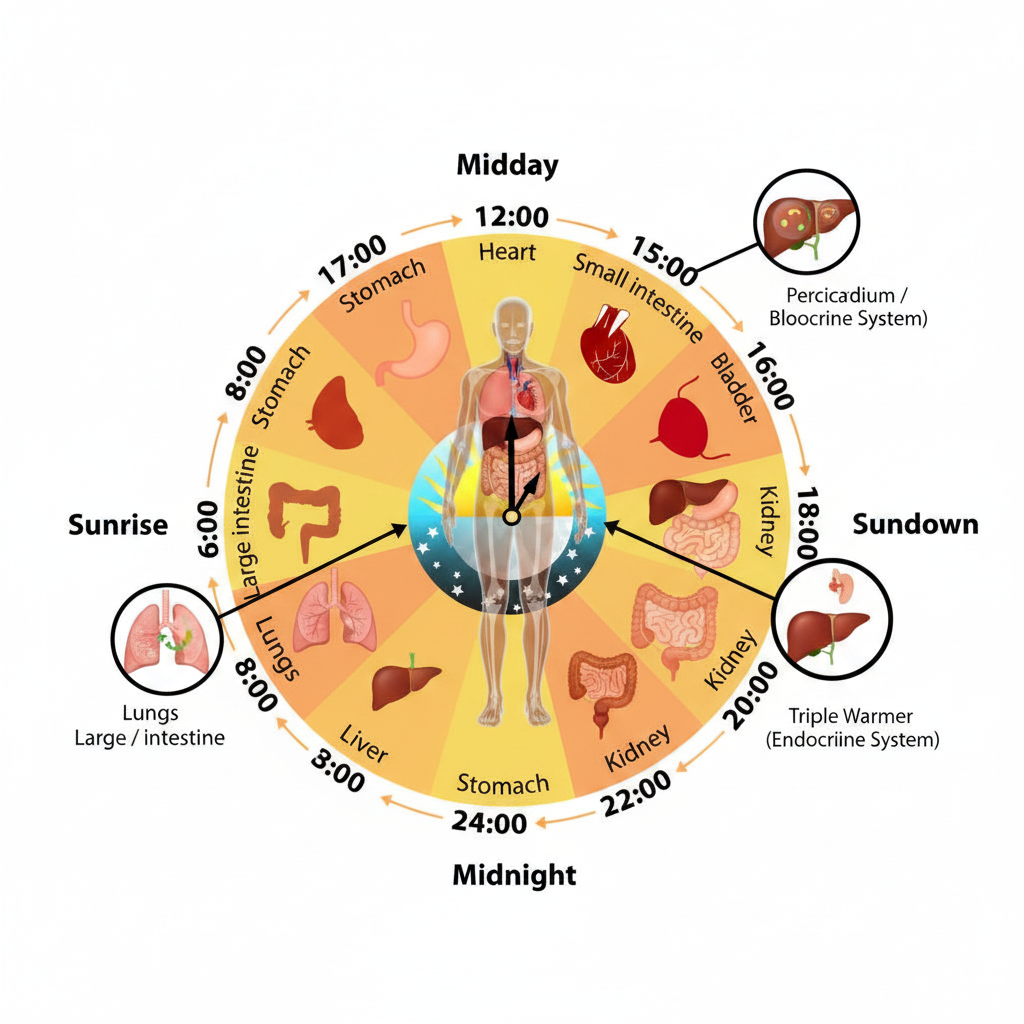
Ever wonder why you’re suddenly wide awake at 3 AM, staring at the ceiling? Or why you feel a surge of energy at certain times, then crash? Listen up, because your body’s got a secret language, and the ancient **Chinese Body Clock** is your decoder ring. This isn’t just some old wives’ tale; it’s a powerful concept from **Traditional Chinese Medicine (TCM)** that maps out when your organs hit their peak performance. Think of it as your internal operating manual, designed to help you optimize your energy and well-being by aligning your day with your body’s natural rhythms.
For instance, according to this wisdom, your lungs are basically rockstars between 3 AM and 5 AM – making it the perfect window to get your sweat on. While some folks might raise an eyebrow, demanding “scientific proof,” let’s be real: your body does have an internal clock that dictates how you function. So, while the direct scientific validation for every single TCM claim is still catching up, the core idea of working with your body’s natural timing? That’s just smart living.
What is the Chinese Body Clock?
At the heart of Traditional Chinese Medicine lies the concept of **Qi** (pronounced “chee”), often translated as “vital energy.” But don’t just think of it as some mystical force; Qi is the very essence of energy in every sense imaginable. It’s the invisible current flowing through everything – from your own being to the objects around you, your emotions, the light, the heat. TCM isn’t just about treating symptoms; it’s about understanding how this Qi manifests, shifts, and how you can master its balance to unlock harmony and true wellness within yourself.
It all boils down to a fundamental truth: a system where all its parts are grooving together, in perfect sync, thrives and endures. But let one piece fall out of whack, let one gear grind, and watch the whole damn system start to unravel. This isn’t just philosophy; it’s a universal law, especially true for the intricate masterpiece that is the human body. So, when your Qi is flowing freely and harmoniously, you’re not just healthy, you’re genuinely content. But when that harmony gets disrupted? That’s when the pain, the illness, and the general malaise kick in.
This disharmony can manifest in countless ways. Maybe you’re starving for proper nutrition, craving physical activity, or feeling a deep void from lack of social connection – all these are just different faces of Qi imbalance. On the flip side, too much of a good thing can also throw you off: overeating, over-exercising, drowning in pollution, or letting emotions like worry and anger run wild. These aren’t just minor annoyances; they’re signals your body is sending, loud and clear [1].
TCM offers a whole arsenal of strategies to get your well-being back on track, and the **Chinese Body Clock** is one of its sharpest tools. The core theory? You can literally hit the reset button on your health and vitality by tuning into your body’s natural energy surges and the unique productivity cycles of your vital organs. It’s about working smarter, not harder, with the incredible machine that is YOU [2].
The Clock’s Intervals: Your Organ’s Prime Time Schedule
Get ready to discover when your internal powerhouses are at their absolute best. Pay attention, because understanding these intervals can be a game-changer for your daily routine and overall health.
5 AM–7 AM: The Large Intestine’s Big Moment
Wakey, wakey! These early hours are when your large intestine is primed for action. It’s time to honor your body’s natural excretion process. Get things moving, literally, and feel lighter for the day ahead.
9 AM–11 AM: Spleen in the Spotlight
Your spleen isn’t just chilling; it’s a vital player in managing your blood cell levels, fighting off nasty infections, and keeping your fluid balance in check. Even though it’s part of the lymphatic system, it sits right above your stomach. During these hours, your **Qi** is surging upwards, giving your spleen the boost it needs to do its critical work.
11 AM–1 PM: Heart’s Calling the Shots
This is prime time for your heart, the ultimate symbol of peace and emotional balance. So, what’s the advice? Chill out! Seriously, this isn’t the time to crank up the stress. Protect your ticker, keep calm, and carry on.
1 PM–3 PM: Small Intestine’s Power Hour
Feeling hungry after lunch? Good! At this point, your **Qi** is expanding through your small intestine, supercharging its digestive power. This means your body is perfectly prepped and more likely to handle those heavier foods you just devoured. Digest like a boss!
Shutterstock
3 PM–5 PM: Bladder & Kidneys on Cleanup Duty
These hours are all about your bladder and kidneys, working in tandem like a finely tuned detox squad. Their mission? To flush out all those unwanted substances from your system. Plus, according to TCM, your kidneys are the ultimate storage vaults for your precious **Qi**. Keep them happy!
7 PM–9 PM: Pericardium’s Protective Embrace
Now we’re talking about the pericardium – that crucial, fluid-filled sac literally guarding your heart. During this window, your **Qi** is supposedly getting regulated, a natural shield against nasty symptoms like nausea, vomiting, and other unsettling vibes. It’s your body saying, “Time to settle down.”
9 PM–11 PM: The “Triple Burner” Fires Up
This mysterious “triple burner” isn’t a single organ; it refers to your entire organ system getting into gear. These hours are when your body is said to generate the most heat. Think of it as your internal furnace, revving up for crucial nighttime processes.
1 AM–3 AM: Liver’s Late-Night Shift
Your liver is pulling an all-nighter during these hours, focusing intensely on its critical cleansing and detox functions. So, what’s the smart move? Eat a light dinner much earlier in the evening. Give your liver a break, let it focus on purifying your system without the burden of heavy digestion.
3 AM–5 AM: Lungs Ready to Rock
Ever heard of the “pre-dawn workout”? There’s a reason! These hours are considered prime time for exercise because your lungs are operating at their absolute peak efficiency. If you’re looking for an energy boost and a clear mind, this might just be your magic window.
Current Research About Body Clocks: Not Just Ancient Wisdom, It’s Science Too!
Hold up! While the ancient **Chinese Body Clock** might sound like something from a bygone era, its underlying logic is surprisingly grounded in modern science. Your body isn’t just one big clock; it’s a symphony of many intricate internal timekeepers. And here’s the kicker: when you learn to work with them instead of constantly fighting against them, your health can seriously level up.
Take the **circadian rhythm**, for example – probably the most famous of your internal clocks. This master timekeeper dictates your daily schedule: when you start feeling sleepy at night, when you naturally wake up in the morning, and when your stomach starts rumbling for lunch. These body clocks are deeply intertwined with your metabolism, influencing virtually every single function in your body. It’s a complex, beautiful dance.
But here’s where we mess it up. We constantly battle our **circadian rhythm** by burning the midnight oil, hopping across time zones like it’s nothing, or staring at bright screens way past bedtime. Guess what? This isn’t just “pushing through”; it’s actively sabotaging the delicate functioning of your internal body clocks. And the consequences? They’re no joke. Research is increasingly drawing a stark line between deregulated circadian rhythms and a higher risk of chronic diseases.
“Epidemiological studies are consistently revealing more and more connections between modern lifestyles and our internal biological clock, and when those two clash, it can lead to development of diseases such as obesity and breast cancer,” warns study author Steve Kay, Provost Professor of Neurology, Biomedical Engineering and Biological Sciences. So, next time you’re tempted to ignore your body’s natural signals, remember: you might be setting yourself up for more than just a bad night’s sleep.
There you have it – a peek into the powerful world of the Chinese Body Clock and how it connects to your modern life. Understanding these rhythms isn’t just about ancient wisdom; it’s about unlocking a healthier, more balanced you. Ready to dive deeper into optimizing your well-being?
Stay tuned for more mind-blowing insights into health, wellness, and the secrets your body holds. Keep exploring our site for articles that will empower you to live your best life. We love having you here, and we’re committed to bringing you nothing but the best!