 By admin
 Achieving Accurate Blood Pressure Readings: Why Arm Position Matters, According to Johns Hopkins Research
During routine blood pressure checks, it’s common for individuals to overlook the seemingly minor detail of arm position, often assuming the readings are entirely precise. However, this seemingly insignificant factor can profoundly impact the accuracy of your results, potentially altering your health assessment. Emerging research, particularly from medical experts at Johns Hopkins, underscores the critical influence of subtle postural variations during blood pressure measurement. These findings offer a vital new perspective on standard health monitoring practices. Intriguingly, a widespread habit could inadvertently inflate your blood pressure readings. Continue reading to discover this crucial insight and understand why its impact on your cardiovascular health is more significant than you might imagine.
Understanding the Basics of Blood Pressure Measurements
Blood pressure measurements serve as a crucial indicator of your heart and arterial health at any specific time. These readings are composed of two distinct figures: the systolic pressure, which reflects the force exerted when your heart contracts to pump blood, and the diastolic pressure, representing the pressure in your arteries when your heart rests between beats. Medical professionals rely on these values to evaluate overall cardiovascular well-being. Beyond these fundamental aspects, numerous variables can sway your blood pressure results, including the time of day, recent physical activity, and even caffeine consumption. Significantly, growing evidence highlights arm positioning as another critical, yet frequently overlooked, factor in clinical environments. The implications are profound: imprecise readings could lead to unwarranted anxiety or, conversely, mask genuine health concerns. Therefore, meticulous attention to details such as proper arm posture is paramount for obtaining the most dependable health data.
Key Findings from the Johns Hopkins Study on Arm Position
A groundbreaking study conducted by Johns Hopkins Medicine meticulously investigated the impact of various arm positions on blood pressure measurements. The research involved 133 adult participants, who underwent blood pressure checks in three distinct, commonly adopted postures: with their arm supported on a desk, resting their hand on their lap, and with their arm hanging unsupported at their side. The findings were remarkably insightful. Compared to the desk-supported position—considered the gold standard—placing the hand on the lap resulted in average increases of 3.9 mmHg for systolic pressure and 4.0 mmHg for diastolic pressure. Even more pronounced discrepancies were observed when the arm was left unsupported at the side, yielding an average increase of 6.5 mmHg for systolic readings and 4.4 mmHg for diastolic readings. Crucially, these differences are far from negligible. Such variations possess the potential to reclassify a blood pressure reading from a healthy range into one warranting additional medical scrutiny. Furthermore, the study highlighted the consistent nature of these effects across diverse demographic groups, indicating its universal relevance irrespective of age or background. This evidence strongly corroborates existing medical guidelines that advocate for a fully supported arm at heart level to ensure maximum measurement accuracy.
Why Arm Position Influences Blood Pressure Readings
The influence of gravity on blood flow during blood pressure measurement is more significant than commonly understood. If your arm is not positioned at the same level as your heart, it can exert additional hydrostatic pressure on the arteries, resulting in artificially elevated readings. For example, an arm left dangling creates a downward pull on the blood, compelling the heart to work harder to overcome this resistance. This physiological response mimics a state of elevated blood pressure that does not accurately represent your actual baseline. Decades of research consistently demonstrate that even minor deviations in arm height, sometimes just a few inches, can inflate readings by 4 to 7 mmHg. Such an increase is substantial enough to misclassify an individual’s blood pressure during routine health assessments. It is noteworthy that despite these established facts, many clinical environments continue to measure blood pressure with patients in suboptimal, casual postures, often due to time pressures or ingrained habits. Awareness of this critical detail empowers patients to proactively request and ensure proper measurement techniques during their medical appointments.
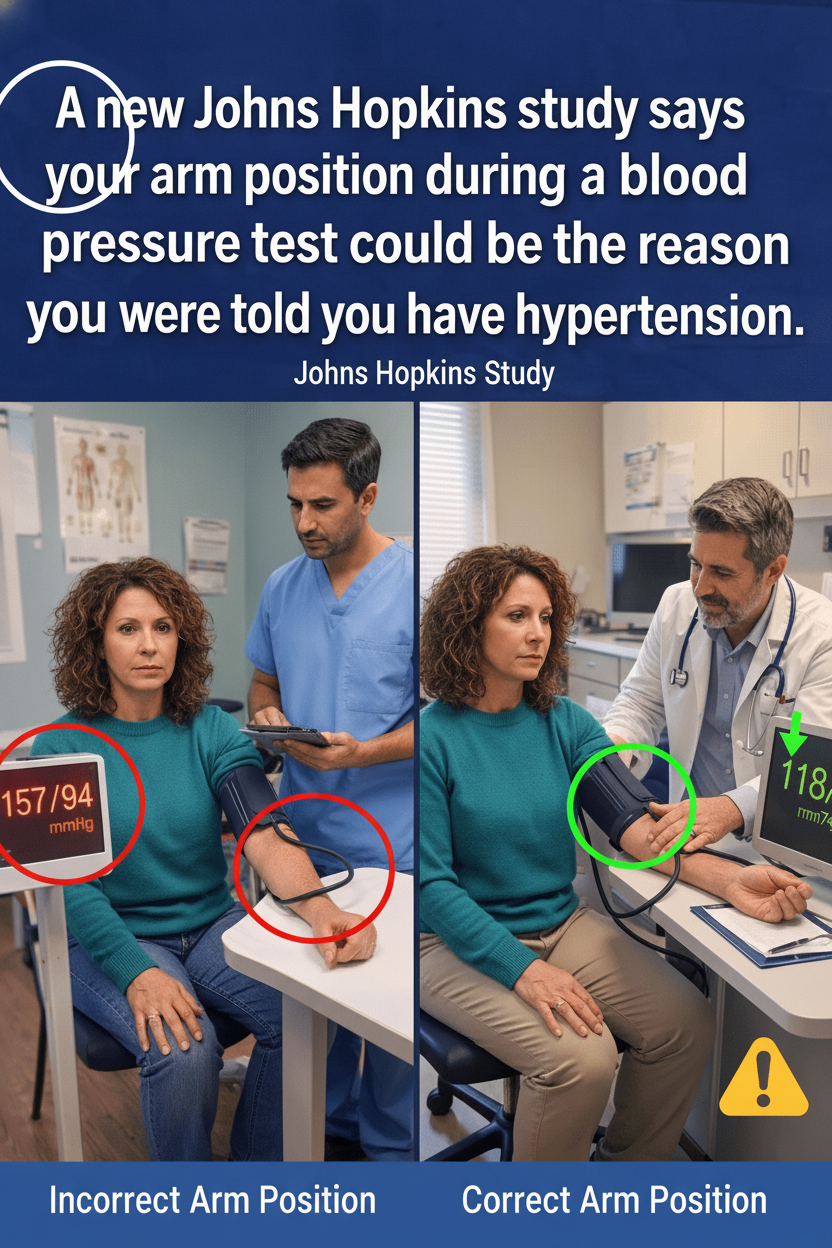
Common Arm Positions and Their Effects: A Comparison
To further illustrate these crucial differences, the following table summarizes the average variations in blood pressure readings for common arm positions, relative to the ideal desk-supported method, based on the comprehensive Johns Hopkins findings.
| Arm Position | Systolic Reading Difference (mmHg) | Diastolic Reading Difference (mmHg) |
|---|---|---|
| Supported on Desk (Heart Level) | 0 (Baseline) | 0 (Baseline) |
| Hand Resting on Lap | +3.9 | +4.0 |
| Arm Hanging Unsupported at Side | +6.5 | +4.4 |
Evidently, the arm supported on a desk at heart level represents the benchmark for accuracy. While placing the hand on the lap offers comfort, it consistently leads to a moderate overestimation of blood pressure. The most substantial inflation in readings occurs when the arm hangs unsupported at the side, a factor that could significantly influence medical diagnoses and treatment plans. This comparative data clearly underscores how seemingly minor postural decisions during measurement can accumulate to critical inaccuracies over time.
Step-by-Step Guide to Proper Arm Position for Accurate Readings
Armed with this essential knowledge, you can actively contribute to the accuracy of your blood pressure measurements. Here’s a clear, step-by-step guide to ensure proper arm positioning during your next check-up, aligning with expert health guidelines and promoting more consistent, reliable results.
- Sit Properly: Always sit upright in a chair with your back supported and your feet flat on the floor. Avoid crossing your legs.
- Rest for a Few Minutes: Before the measurement, sit quietly for at least 5 minutes. Avoid talking during the measurement.
- Position Your Arm: Place your arm on a flat surface, such as a desk or table, so that the middle of the cuff is at the same level as your heart. Your arm should be relaxed, not tensed.
- Ensure Support: Your arm should be fully supported, not dangling or held up by your own muscle effort.
- Remove Tight Clothing: Roll up any tight sleeves that might constrict your arm.
By diligently following these simple yet crucial steps, you can significantly enhance the reliability of your blood pressure readings, providing your healthcare provider with the most accurate data for your cardiovascular health assessment.