 By admin
 It’s often tempting to dismiss a subtle change in your breast. A minor discoloration, a subtle swelling, or a slight indentation might initially appear innocuous. However, overlooking these seemingly small alterations can lead to significant consequences. The empowering reality is that identifying early warning signs and responding swiftly can profoundly impact your health outcomes. By the conclusion of this comprehensive guide, you will have a clear understanding of the specific indicators that demand immediate medical attention.
Why Early Detection Changes Everything
Breast cancer often develops without immediate symptoms, typically originating in the milk ducts or glands. At its initial, non-invasive stage (Stage 0), the prognosis is exceptionally favorable, with survival rates approaching 99%, as reported by the American Cancer Society. However, once the disease extends beyond the localized breast tissue, prognosis and treatment options become considerably more intricate.
Consider these critical facts:
- Average Delay in Seeking Medical Care: Typically 8 to 12 weeks after noticing a change.
- Critical Window for Evaluation: Ideally within the first 4 weeks of observing any new symptom.
- Survival Impact: A significant difference in survival rates exists between early-stage and advanced-stage diagnoses.
The crucial distinction often lies in proactive awareness and timely intervention. Let’s now explore the 10 warning signs, progressing from the more subtle to the most urgent indicators.
10. Subtle Changes in Breast Size or Shape
An early indicator could be one breast appearing marginally larger or more swollen than the other, particularly if there’s no clear hormonal explanation. Pay close attention if:
- The change exclusively affects one breast.
- It persists for more than two weeks.
- It is not attributable to pregnancy or your menstrual cycle.
- It is accompanied by a new feeling of firmness.
Leading medical research indicates that new or increasing breast asymmetry can be one of the initial observable signs. A helpful habit is to take monthly photos in consistent lighting to track any potential alterations over time.
9. Skin Texture Changes: Dimpling or Puckering
Should the skin on your breast begin to resemble the dimpled texture of an orange peel—a condition medically known as peau d’orange—it could signify underlying structural changes. This phenomenon occurs for several reasons:
- Tumor Pulling Tissue: A tumor growing beneath the surface can pull on ligaments, creating noticeable dimples. This is commonly associated with invasive ductal cancer.
- Lymphatic Blockage: Blockage of the lymphatic vessels can lead to skin thickening and a pitted appearance, often seen in inflammatory breast cancer.
- Fibrosis: Scar tissue (fibrosis) can cause the skin to pucker or indent.
Research from institutions like Johns Hopkins suggests that these skin alterations can sometimes manifest even before a palpable lump is detected. To perform a self-check:
- Relax your arms at your sides.
- Press your hands firmly on your hips.
- Raise your arms overhead.
- Gently pinch the skin to check for any unusual indentations.
Any persistent dimpling or puckering warrants immediate evaluation by a healthcare provider.
8. Persistent Itching or Irritation
While occasional breast itching is a common, often harmless occurrence, persistent itching, especially when accompanied by redness or warmth, is not typical. Though uncommon, inflammatory breast cancer (IBC) can manifest with these symptoms.
Distinguishing between normal and concerning symptoms:
- Mild Itching:
- Typical Duration: 1 to 3 days.
- When to Seek Care: If it persists for weeks.
- Temporary Redness:
- Typical Duration: Brief.
- When to Seek Care: If it becomes persistent.
- Warmth:
- Typical Duration: Short-term.
- When to Seek Care: If it is constant.
If you experience ongoing itching alongside swelling or noticeably thickened skin, it’s crucial to seek prompt medical evaluation.
7. Hard, Irregular Lumps
While not all breast lumps indicate cancer—many are benign cysts or fibroadenomas—their specific characteristics are vital for differentiation. Here’s how benign and potentially concerning lumps often compare:
| Feature | Often Benign | Needs Evaluation (Concerning) |
|---|---|---|
| Shape | Smooth, round, or oval | Irregular, indistinct edges |
| Movement | Moves easily within the breast tissue | Fixed or anchored to surrounding tissue |
| Edges | Well-defined, distinct | Uneven, jagged, or poorly defined |
| Pain | Sometimes tender or painful | Often painless, but can be painful |
| Growth | Stable in size | Increasing in size |
The American Cancer Society notes that most suspicious breast lumps tend to feel firm, irregular, and distinct from surrounding tissue. It’s also important to remember that men can develop breast cancer, though it is considerably less common.
6. Persistent, Localized Breast Pain
The majority of breast pain is linked to hormonal fluctuations and typically affects both breasts. However, pain that is persistent, occurs in only one breast, feels deep, and is localized to a specific area warrants a discussion with a healthcare provider. While pain by itself is not a definitive indicator of cancer, its presence, especially when coupled with other warning signs, escalates the level of concern.
5. Unexplained Swelling
Unexplained swelling, either in the breast itself or in the underarm (axillary) region, particularly in the absence of a distinct lump, could indicate involvement of the lymph nodes. To check your underarm area:
- Raise one arm slightly.
- Use your opposite hand to gently feel the front, middle, and back areas of your armpit.
- Note any firm, enlarged, or tender lymph nodes.
This type of swelling, even without a palpable mass, can sometimes be linked to more aggressive forms of breast cancer.
4. Nipple Retraction
If a nipple suddenly begins to turn inward or appear inverted, especially if it was previously everted (pointing outward), this change should never be overlooked. Key warning signs include:
- Recent onset of the retraction.
- It occurs in only one breast.
- The change is progressive or worsens over time.
- It is combined with any nipple discharge.
Invasive ductal carcinoma, the most common type of breast cancer, is frequently associated with new-onset nipple retraction.
3. Red, Flaky, or Thickened Skin
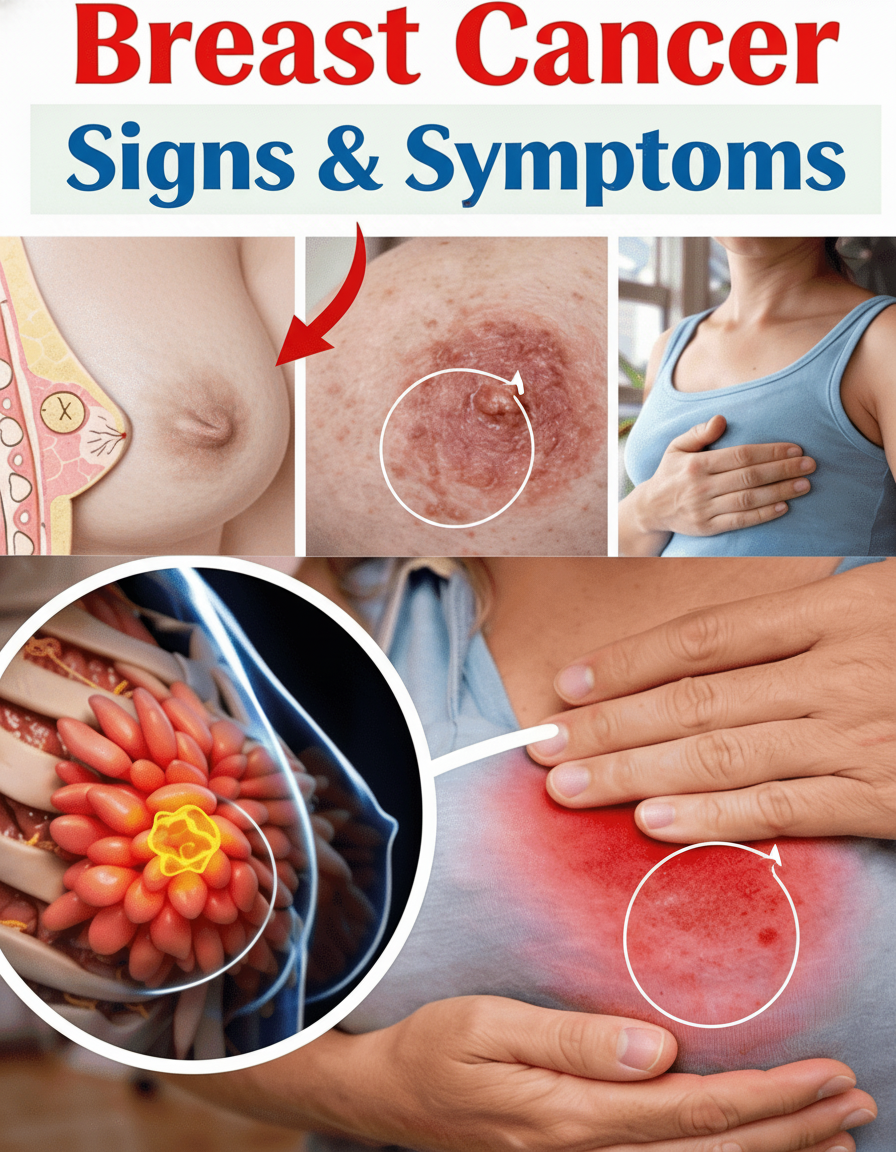
Persistent redness, flakiness, or thickening of the skin on the breast or nipple, which might resemble eczema or dermatitis, should be examined by a doctor. Unlike typical skin conditions, these changes may not respond to standard topical treatments and can sometimes indicate conditions like Paget’s disease of the nipple or inflammatory breast cancer.
(Note to reader: The original source material for this guide concluded at this point, providing information for signs 10 through a partial 3. For a comprehensive list of all potential breast cancer warning signs, please consult a trusted medical resource or healthcare professional.)