 By admin
 Do you frequently wake up feeling stiff, experiencing a persistent ache in your lower back, or enduring a nagging neck discomfort that shadows your entire day? You might be surprised to learn that your sleep posture – the way your body rests for those crucial 7-9 hours each night – significantly influences your spinal well-being and how you feel upon waking. Suboptimal alignment during sleep can impose undue stress on your muscles, joints, and delicate nerves, transforming simple daily movements into a struggle. The encouraging news is that even minor modifications to your sleeping routine can foster superior spinal alignment, potentially alleviating that unwelcome morning discomfort. Interestingly, many individuals underestimate the profound impact of small adjustments, such as strategic pillow placement, on their overall sense of restfulness and mobility. Continue reading to explore expert-recommended sleep positions and identify habits you might need to reconsider for optimal spinal health.
Why Your Sleep Posture Is Crucial for Spinal Health
Your spine is an intricate structure, designed with natural curves that are essential for absorbing shock, distributing weight, and providing robust support for your entire body. When you sleep, the objective is to maintain these vital curves in a neutral, unstrained position. This neutral alignment is paramount as it minimizes uneven pressure on your spinal discs, muscles, and nerves, preventing cumulative stress. Extensive research, including various studies on sleep posture and its correlation with spinal symptoms, consistently indicates that individuals who adopt positions promoting neutral alignment tend to report significantly less morning discomfort.
Consider it this way: when your spine is properly supported and aligned, it gains the invaluable opportunity to genuinely rest and recuperate from the day’s demands. Conversely, inadequate support allows gravity and your body weight to pull your spine out of its natural equilibrium, resulting in persistent tension and potential misalignment that can exacerbate over hours of sleep.
Optimal Sleep Positions for Superior Spinal Alignment
Health professionals widely endorse several sleeping positions that are highly effective in promoting a neutral spinal state. These strategies primarily involve the strategic use of pillows to support your body’s natural contours and maintain proper alignment throughout the night.
1. Back Sleeping with Knee Support
Frequently hailed as a premier choice for comprehensive spinal support, sleeping on your back facilitates an even distribution of your body weight. To further enhance this position, placing a small pillow or a rolled towel beneath your knees is highly recommended. This simple addition helps to maintain the natural inward curve of your lower back (lumbar spine), thereby significantly reducing strain on the lumbar muscles and spinal discs.
- How to Implement: Begin by selecting a relatively thin pillow for your head, ensuring your neck remains in a neutral position – neither excessively elevated nor too flat. Subsequently, introduce support under your knees, adjusting it until your lower back feels comfortably settled and fully supported by the mattress.
2. Side Sleeping with a Pillow Between Your Knees
Side sleeping is a widely adopted position that can be exceptionally beneficial for spinal health when executed correctly. This posture effectively promotes better alignment of your hips, pelvis, and spine, particularly when your knees are slightly bent. The crucial element here is to place a firm pillow between your knees. This prevents your top leg from falling forward and rotating your lower spine, which can lead to uncomfortable twisting and misalignment.
- Key Recommendations: For enhanced overall support, consider using a body pillow that extends from your head to your knees. Additionally, ensure the pillow supporting your head adequately fills the void between your shoulder and ear, maintaining cervical spine neutrality.
3. Gently Reclined with Strategic Support
For certain individuals, adopting a semi-reclined posture – often achieved with an adjustable bed or a specialized recliner – can be particularly advantageous. This position can help to subtly decompress the spaces between vertebrae and alleviate specific pressure points, offering significant relief if traditional flat sleeping positions induce tension or discomfort.
- Practical Setup: To achieve this, utilize pillows to elevate your upper body to a gentle angle, typically between 30-45 degrees. Crucially, remember to incorporate support under your knees to ensure consistent lower back comfort and maintain its natural curve.
4. Back Sleeping with Optimized Neck Support
This variation of back sleeping emphasizes precise head and neck alignment, which is critical for preventing cervical spine strain. The goal is to use a pillow that gently cradles the natural curvature of your neck, ensuring your chin is not pushed excessively towards your chest. A contour or memory foam pillow designed for neck support can be particularly effective here.
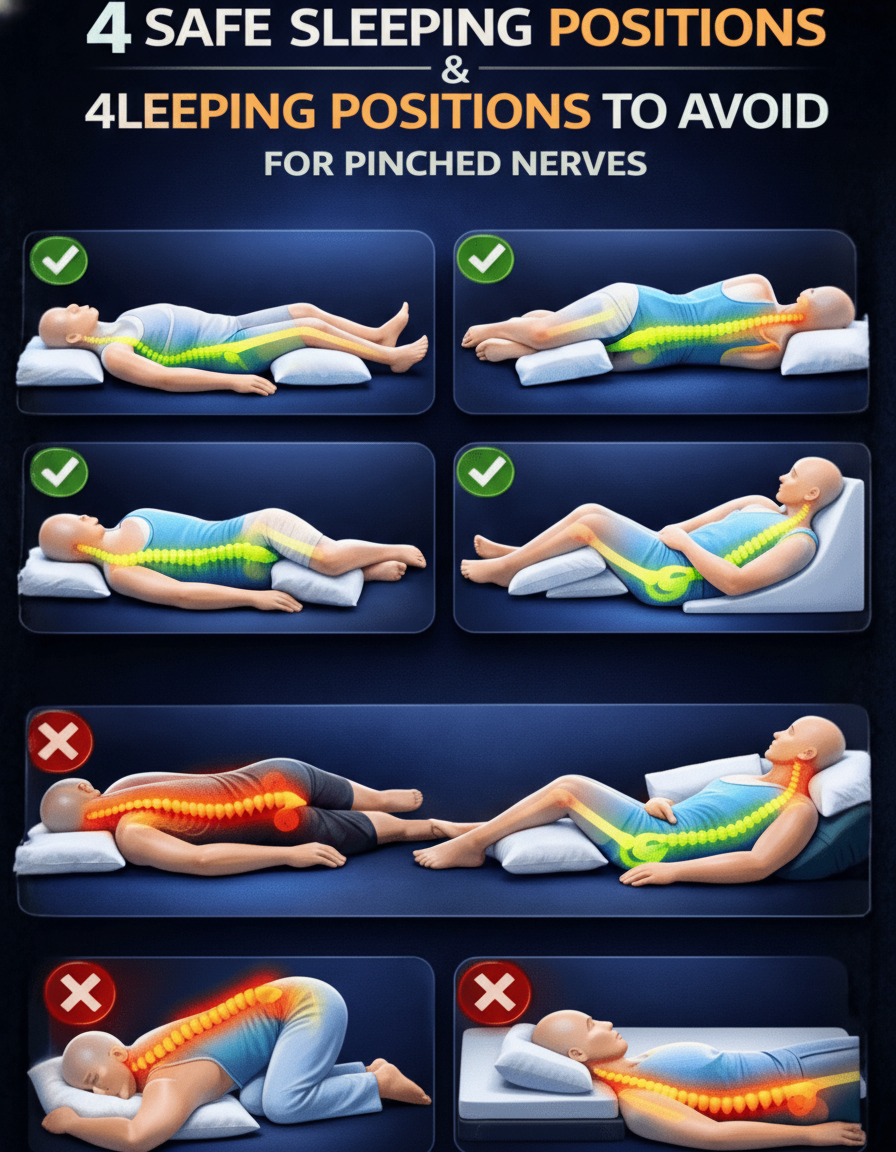
Ultimately, all these recommended positions are designed to foster a neutral spinal alignment, a principle that numerous health authorities associate with a significant reduction in overnight strain and improved overall spinal well-being.
Sleep Positions and Habits to Avoid for Spinal Health
While some sleeping positions are highly beneficial, others can actively contribute to spinal stress and discomfort. It’s vital to identify and reconsider these less supportive habits to protect your long-term spinal health.
1. Stomach Sleeping
Sleeping on your stomach is widely regarded as one of the most detrimental positions for spinal health. This posture not only flattens the natural lumbar curve of your lower back but also compels your neck to twist sharply to one side for breathing. This extreme rotation places immense, uneven stress on your cervical spine and surrounding muscles, leading to potential stiffness, pain, and long-term issues.
2. Excessive Head Pillow Stacking
While a pillow is essential, using an excessive number of pillows or one that is too thick can be counterproductive. Stacking multiple pillows or using a very lofty one forces your head into an unnatural forward flexion, pushing your chin towards your chest. This sustained unnatural angle creates significant strain on your neck and upper spine throughout the night.
3. Lack of Targeted Support for Neck or Knees
Neglecting to use pillows in critical areas, such as under the neck (when back sleeping) or between the knees (when side sleeping), can lead to considerable misalignment. Without this targeted support, your hips and shoulders can twist or drop out of alignment, resulting in awkward and strained postures that pull on your lower back and other spinal segments.
4. Unsupported or Extreme Fetal Positions
While a gentle fetal position can be acceptable for some side sleepers, extreme curling or uneven leg placement without proper support can be problematic. Overly tight fetal positions can round the spine excessively, and allowing one leg to drop forward without a pillow between the knees can twist the lower back and pelvis. Research on sleep postures consistently indicates that prone (stomach) sleeping, in particular, is associated with significantly higher spinal stress compared to properly supported back or side sleeping positions.
Quick Reference: Spine-Friendly vs. Spine-Stressful Sleep Positions
For a clear overview, here’s a summary of recommended and problematic sleep postures:
- Spine-Friendly (Highly Recommended):
- Back Sleeping with Knee Pillow: Promotes even weight distribution and maintains lumbar curve.
- Side Sleeping with Knee Pillow: Ensures optimal hip, pelvis, and spinal alignment.
- Slight Recline with Support: Can reduce pressure points and decompress vertebrae.
- Spine-Stressful (Limit or Avoid):
- Stomach Sleeping: Leads to flattened lumbar curves and severe neck twisting.
- Excessive Head Pillows: Causes unnatural neck flexion and strain.
- Lack of Targeted Support: Results in hip/shoulder misalignment and twisted postures.
- Extreme/Unsupported Fetal Curl: Can round the spine excessively and twist the lower back.