 By admin
 Do you frequently experience morning stiffness, persistent lower back pain, or an irritating neck ache that follows you throughout your day? Many individuals attribute these discomforts to daily activities, yet the true culprit might be closer than you think: your sleep posture. The way your body is positioned during those crucial 7 to 9 hours of rest significantly impacts your spinal health and overall well-being. Suboptimal alignment throughout the night can impose undue stress on your muscles, joints, and delicate nerves, transforming simple daily movements into challenging tasks.
The encouraging news is that achieving better spinal support doesn’t require drastic measures. Even minor modifications to your sleeping habits can promote proper spinal alignment and dramatically alleviate that morning discomfort. It’s astonishing how often people overlook the profound impact of seemingly small changes—such as the strategic placement of a pillow—on how refreshed and mobile they feel upon waking. Continue reading to explore expert-recommended sleep positions that safeguard your spine, and discover which habits you should reconsider for optimal health.
Why Your Sleep Posture is Crucial for Spinal Health
Your spine is an intricate structure, designed with natural curves—the cervical (neck), thoracic (upper back), and lumbar (lower back) — that are vital for absorbing shock, distributing weight, and supporting your entire body. When you sleep, the objective is to maintain these curves in a neutral, relaxed position. This neutral alignment is paramount as it minimizes uneven pressure on the intervertebral discs, muscles, and nerve pathways, preventing unnecessary strain.
Extensive research, including numerous studies investigating the correlation between sleep posture and spinal symptoms, consistently demonstrates that individuals who adopt positions promoting neutral alignment frequently report reduced instances of morning pain and stiffness. Imagine your spine as a foundational pillar: when it remains correctly aligned, it gains the optimal opportunity to rest, repair, and recover from the accumulated stresses of the day. Conversely, without adequate support, the relentless forces of gravity and your own body weight can gradually distort this alignment, leading to chronic tension, discomfort, and potential long-term issues.
Optimal Sleep Positions for Superior Spinal Alignment
Achieving a truly restorative night’s sleep while safeguarding your spine hinges on conscious positioning and strategic pillow use. Health experts widely endorse several sleeping postures designed to maintain your spine in its most neutral and healthy state. The key lies in utilizing pillows to provide targeted support that respects your body’s natural contours.
1. Back Sleeping with Lumbar Support
Often lauded as the gold standard for comprehensive spinal support, lying on your back ensures an even distribution of your body weight across the widest surface area. To optimize this position, place a small pillow or a rolled towel directly under your knees. This simple addition is crucial for preserving the natural inward curve of your lower back (lumbar spine), thereby significantly alleviating strain on your lumbar muscles and intervertebral discs.
How to Master It: Begin by selecting a relatively thin pillow for your head that keeps your neck (cervical spine) in a neutral position – neither excessively elevated nor completely flat. Experiment with the height of the knee support until your lower back feels comfortably settled and fully supported against the mattress, preventing any arching or flattening.
2. Side Sleeping with Knee Cushioning
Side sleeping is a widely favored position and can be highly beneficial for spinal alignment, provided it’s executed with proper support. This posture is excellent for maintaining alignment across your hips, pelvis, and the entire length of your spine, particularly when your knees are slightly bent towards your chest in a gentle fetal-like curl.
Key to Alignment: The most vital element for side sleepers is to position a firm pillow between your knees. This prevents your upper leg from collapsing forward over your lower leg, an action that can introduce harmful rotational stress to your lower spine and pelvis. For enhanced stability and comfort, a full body pillow can offer superior support, ensuring both your upper and lower body remain correctly aligned. Furthermore, select a head pillow that adequately fills the void between your shoulder and ear, keeping your neck in line with the rest of your spine.
3. Supported Semi-Reclined Position
For certain individuals, particularly those who find lying completely flat uncomfortable or experience increased tension in prone positions, a semi-reclined posture can offer significant relief. This position, often achieved with an adjustable bed or a specialized recliner, can subtly decompress the vertebrae, creating more space and diminishing pressure points along the spine.
Practical Setup: To effectively adopt this position, use several pillows to gently elevate your upper body to a comfortable angle, typically between 30 to 45 degrees. Crucially, remember to incorporate support under your knees to maintain the natural curve of your lower back, ensuring comprehensive comfort and spinal integrity.
4. Back Sleeping with Optimized Neck Support
This approach to back sleeping specifically emphasizes precise head and neck alignment, which is fundamental to overall cervical spine health. The goal is to select a pillow that gently cradles the natural lordotic curve of your neck, rather than one that forces your chin towards your chest or allows your head to tilt backward excessively.
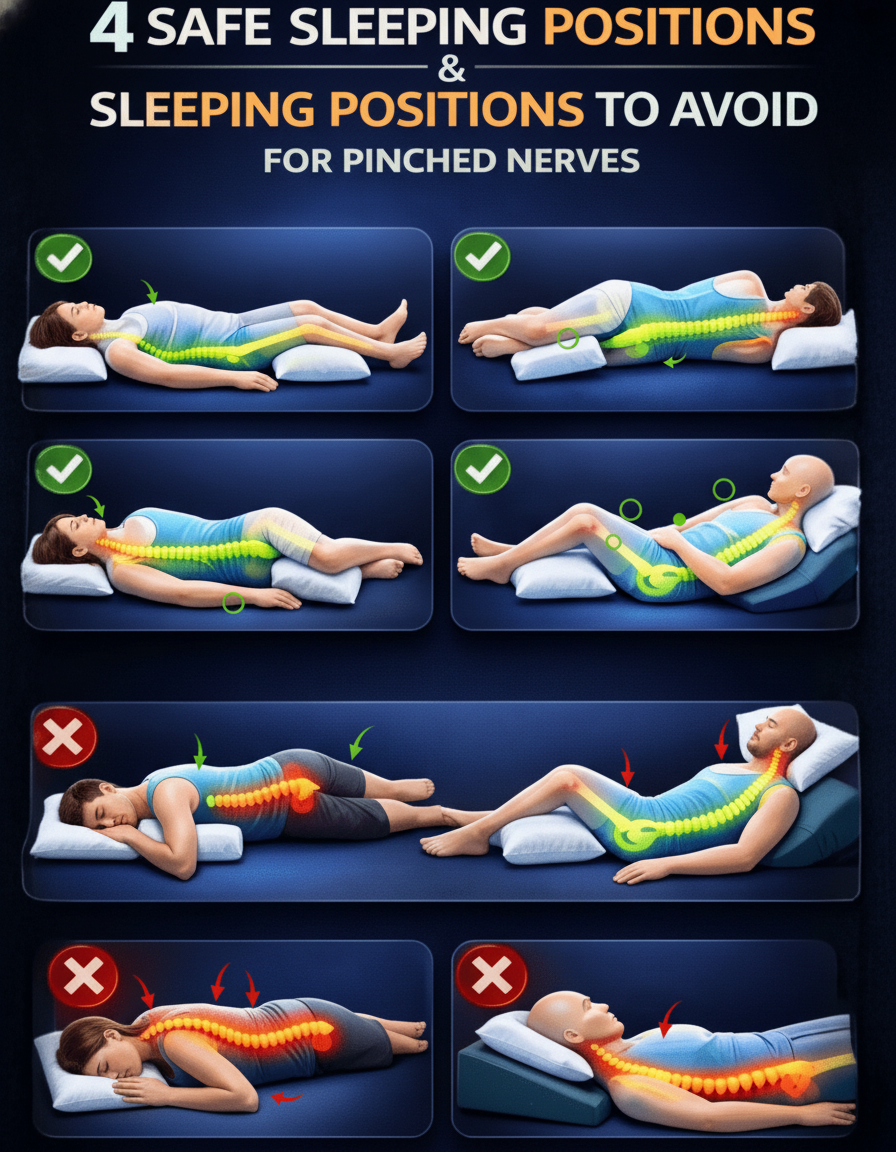
Pillow Selection: Opt for a pillow designed to support the contour of your neck while keeping your head level with your torso. This ensures your cervical spine remains in a neutral position throughout the night. Maintaining this neutral alignment across the entire spine is widely recognized by health professionals as key to minimizing overnight strain and preventing chronic neck and upper back issues.
Sleep Positions and Habits to Avoid for Spinal Wellness
While optimizing your sleep posture can significantly enhance spinal health, it’s equally important to identify and reconsider sleeping habits that can actively undermine your spine’s well-being. Certain common positions, rather than providing rest, can introduce detrimental pressure and misalignment. Here are the postures and habits you should limit or eliminate:
1. Stomach Sleeping (Prone Position)
Sleeping on your stomach is widely regarded by spinal health experts as the least beneficial position. This posture inherently flattens the natural curve of your lower back (lumbar lordosis) and, more critically, compels your neck to remain sharply twisted to one side for hours to facilitate breathing. This sustained rotation places immense, uneven stress on your cervical spine, leading to potential neck pain, stiffness, and even nerve compression. Furthermore, it prevents your spine from achieving a neutral, restorative state.
2. Over-Pillow Use for Your Head
While a supportive pillow is essential, using an excessive number of pillows or one that is too thick can be counterproductive. Stacking multiple pillows or opting for an overly lofty one elevates your head too far forward, effectively pushing your chin towards your chest. This unnatural angle forces your cervical spine into a flexed position for prolonged periods, resulting in significant strain on neck muscles, ligaments, and discs, often manifesting as chronic neck pain or morning headaches.
3. Lack of Strategic Pillow Support
Neglecting to use pillows in critical areas, such as under the neck when back sleeping, or between the knees when side sleeping, can lead to significant misalignment. Without proper cushioning and elevation, your hips and shoulders can fall out of their natural alignment, causing your spine to twist or sag into unsupported, stressful postures. This absence of strategic support contributes to uneven pressure distribution and can exacerbate existing back or neck issues.
4. Uncontrolled or Extreme Sleeping Postures
Adopting overly extreme or unsupported variations of common positions, such as an exaggerated fetal curl or allowing one leg to extend while the other is sharply bent, can create significant torsional stress on your lower back and pelvis. These unbalanced postures pull your spine out of its neutral axis, potentially leading to muscle imbalances and persistent discomfort. Scientific studies on sleep postures consistently indicate that prone (stomach) sleeping, along with these unsupported extreme positions, is associated with markedly higher spinal stress compared to well-supported back or side sleeping.
Quick Reference: Spinal-Friendly vs. Potentially Harmful Sleep Positions
To summarize, making informed choices about your sleep posture is a proactive step toward protecting your spine and improving your overall quality of life. Refer to this quick comparison:
Supportive Positions (Highly Recommended)
- Back Sleeping with Knee Support: Promotes even weight distribution and preserves the natural lumbar curve.
- Side Sleeping with Knee Pillow: Ensures optimal hip-pelvis-spine alignment, preventing rotational stress.
- Slightly Reclined with Comprehensive Support: Can alleviate pressure points and decompress vertebrae for certain individuals.
Potentially Problematic Positions (Limit or Avoid)
- Stomach Sleeping: Flattens lumbar curve, induces severe neck twisting, and causes uneven spinal load.
- Excessive Head Pillow Use: Forces cervical spine into unnatural flexion, leading to neck strain.
- Lack of Strategic Support: Results in misaligned hips and shoulders, contributing to twisted or sagged spinal postures.
By thoughtfully adjusting your sleep environment and adopting these expert-backed positions, you can significantly reduce morning discomfort, enhance your spinal health, and wake up feeling truly refreshed and ready to face the day.