 By admin
 Honeybee Venom Unleashed: Australian Research Reveals a Deadly Blow to Aggressive Breast Cancer Cells!
Hold up, folks! What if the very thing that makes you jump when a bee gets too close is actually the game-changer in the fight against cancer? Australian researchers just dropped a bombshell: they’ve potentially unearthed a brutal, effective weapon against some of the nastiest breast cancer types, and it’s all thanks to honeybee venom. Forget the sting for a sec; the chemicals packed in that insect’s punch might just be the solution doctors have been desperately hunting for.
Breast Cancer in the U.S.
Let’s get real for a moment. The stats are grim: roughly 12% of women in the U.S. will face a breast cancer diagnosis in their lifetime. And get this – by the end of 2020 alone, a staggering 325,000 new cases were projected to hit homes across the nation [1]. That’s not just numbers; that’s lives.
But here’s the real kicker: a significant chunk, about 10-20% of these cases, are the absolute worst. We’re talking triple-negative or HER-2 enriched breast cancer – the kind that plays dirty, hits hard, and laughs in the face of conventional treatments [2, 3]. These are the aggressive breast cancer cells that have been a nightmare for patients and doctors alike.
Read: When this mom found out her daughter bullied a kid at school with cancer, she shaved her head.
Honeybee Venom Kills Cancer
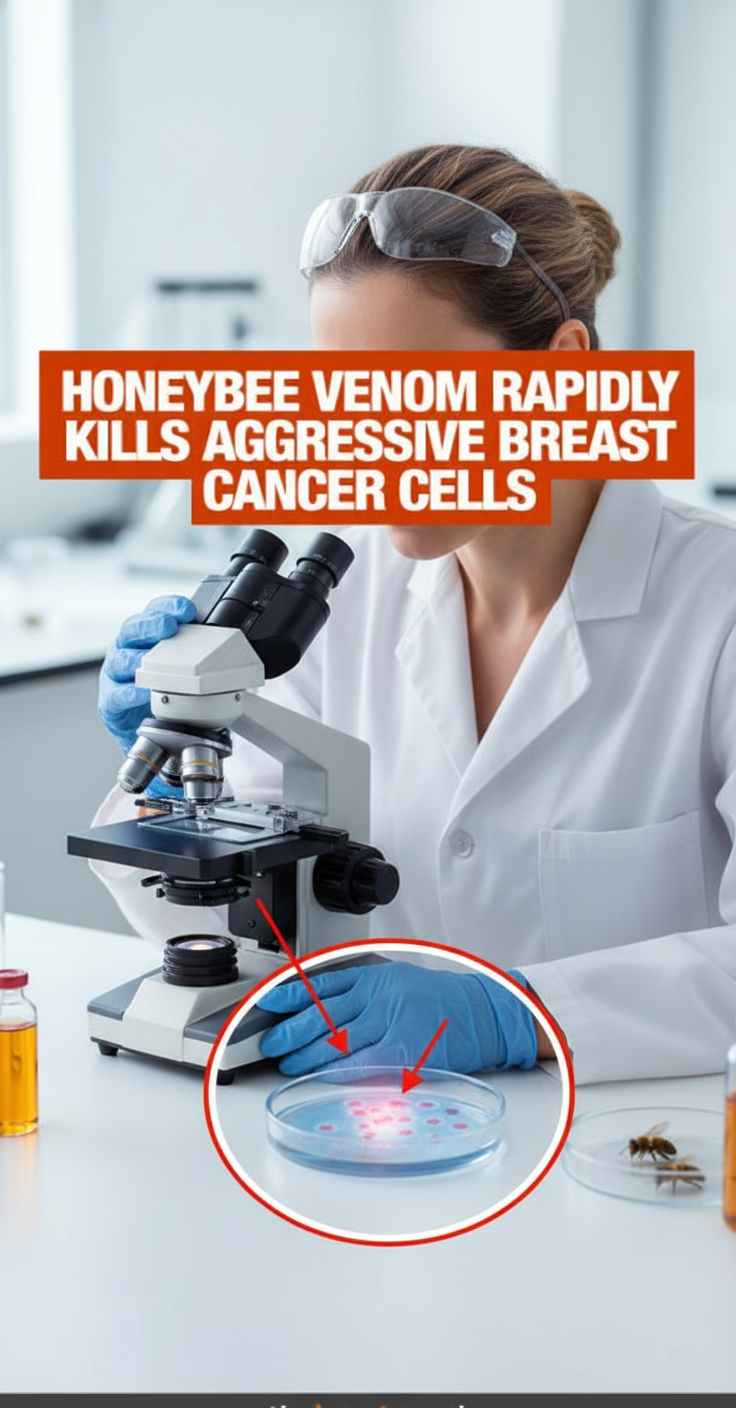
Now, for the good news. Enter Dr. Ciara Duffy, a 25-year-old Ph.D. powerhouse, and her squad at the Harry Perkins Institute of Medical Research in Perth, Australia. They just dropped a bombshell discovery: the venom from honeybees isn’t just a nuisance; it’s a rapid-fire killer of those very same aggressive and hard-to-treat cancer cells [4]. This isn’t just science; it’s hope.
And get this: when they teamed this bee venom up with traditional chemotherapy drugs, it didn’t just work – it slashed tumor growth in mice with brutal efficiency. We’re talking a targeted hit! Specifically, this honeybee venom absolutely decimated triple-negative and HER-2 breast cancer cells, wiping out a full 100% of them within a mere sixty minutes. The best part? It barely laid a finger on healthy cells. Talk about precision!
“We found that the venom from honeybees is remarkably effective in killing some of these really aggressive breast cancer cells at concentrations which aren’t as damaging to normal cells,” Dr. Duffy stated, hitting the nail on the head [4]. Mic drop.
This groundbreaking Australian research, published in the prestigious journal Nature Precision Oncology, wasn’t limited to just local buzzers. They sourced honeybees from Australia, Ireland, and England, though Dr. Duffy did give a shout-out, noting that Perth’s local honeybees are some of the healthiest on the planet [4].
They didn’t just guess; these scientists put the pedal to the metal, testing venom from over three hundred honeybees and bumblebees. The verdict was clear as day: honeybee venom absolutely *crushed* bumblebee venom in terms of potency [5]. No contest.
Read: 8 of the Best Anti-Cancer Foods. It’s Time to Start Adding them to Your Diet
Melittin: Honeybee Venom’s Secret Weapon
So, what’s the secret sauce? While honeybee venom has been dabbling in treatments for other health issues like eczema and melanoma for a while, its molecular mechanics against tumors were a mystery – until now. This fresh research finally cracked the code: the lion’s share of that venom’s **anti-cancer effects** comes from a potent chemical called melittin. This bad boy makes up half the venom and, yep, it’s why a bee sting feels like a tiny, fiery explosion.
It’s the melittin that makes all the difference. Bumblebee venom, despite having its own potential cell-killers, totally fizzled out against cancer cells because it lacks melittin. But the honeybee venom? It was a showstopper, impressively effective where others failed.
“We found that melittin can completely destroy cancer cell membranes within 60 minutes,” declared Dr. Duffy, laying out the brutal truth [6]. That’s a full-on assault.
To ensure melittin was truly the MVP behind the venom’s anti-cancer properties, the researchers pulled a clever move: they blocked the melittin with an antibody. And guess what? When melittin was sidelined, the cancer cells exposed to the venom *survived*. Case closed: melittin is absolutely the critical component.
“This study demonstrates how melittin interferes with signalling pathways within breast cancer cells to reduce cell replication,” chimed in Western Australia’s Chief Scientist Peter Klinken, an independent observer who clearly saw the brilliance [6]. It’s shutting down the cancer’s internal communication system.
Two other benefits to the Bee Venom Molecule
Hold onto your hats, because there are two more massive wins for using melittin in the fight against cancer treatment:
- This powerhouse has little to no impact on healthy cells. It’s a sharpshooter, not a carpet bomber.
- Even better? Melittin can be produced synthetically! That means we don’t need a million bees; we can whip up this miracle compound in a lab, and it delivers the exact same knockout punch as the real deal.
Read: This one photo of